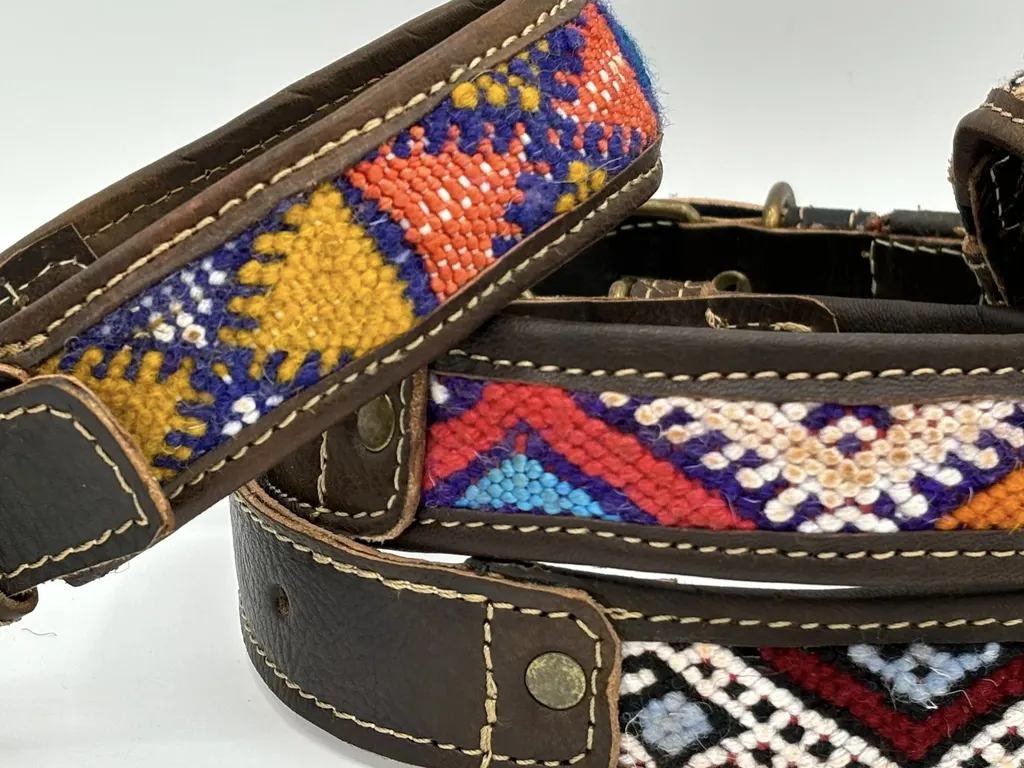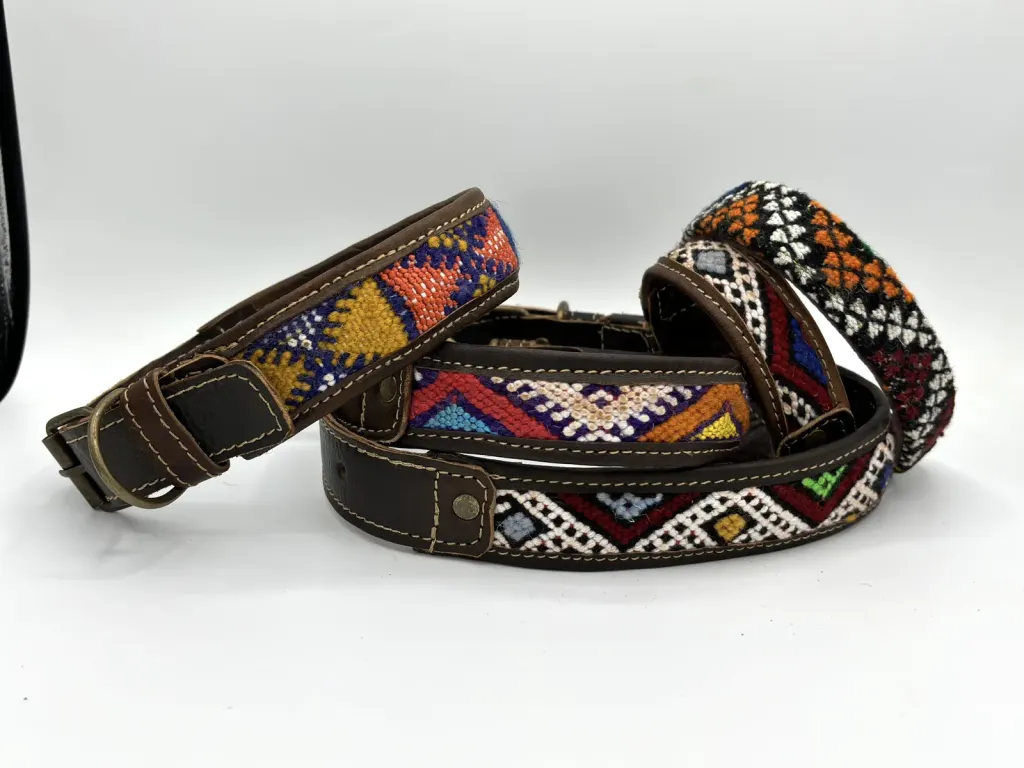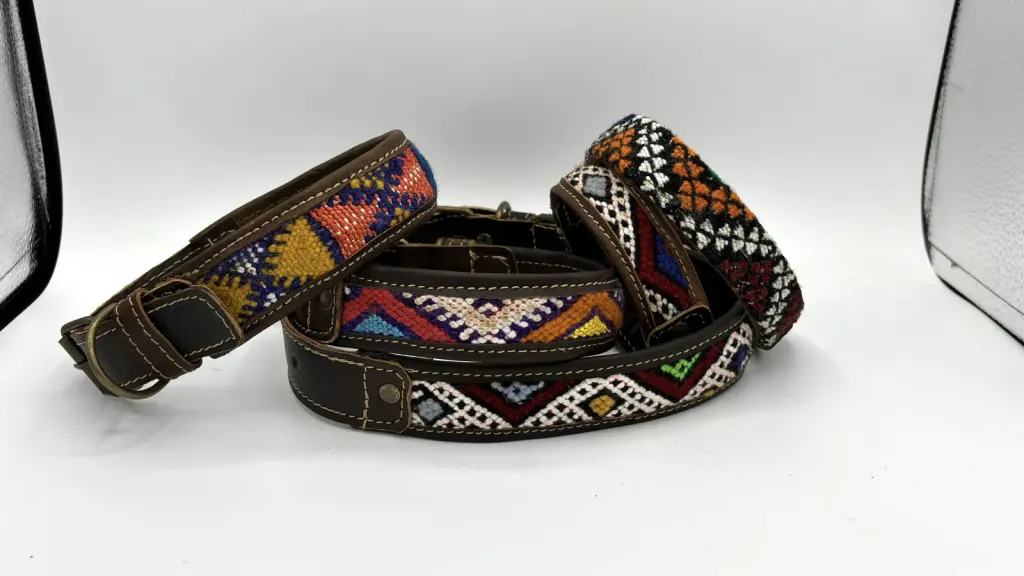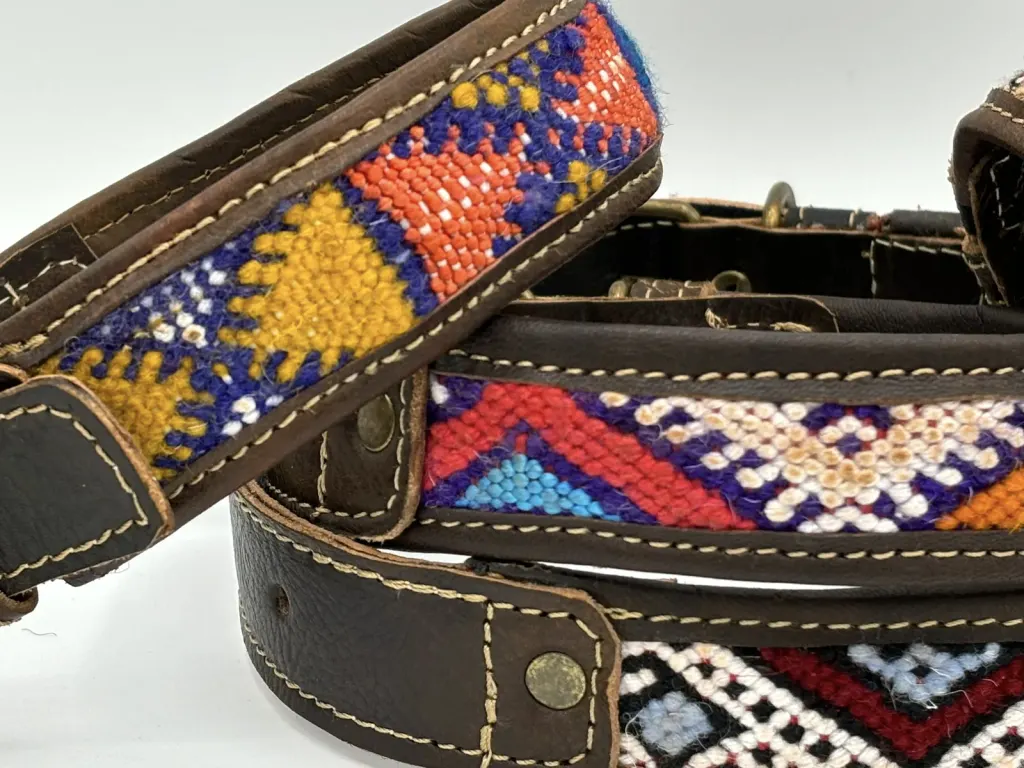
A kilim is a flat-woven textile with no pile. Colored wool threads are packed so tightly across the loom that pattern and cloth are one and the same: no knots, no fuzz, nothing clipped. The word is Persian, and kilims turn up from Turkey to North Africa.
That’s the quick answer. What follows covers how the structure works, how it differs from a rug with a soft surface, and why our dog collars carry woven wool from Morocco.
How is a kilim made?
Start at the loom. Vertical threads, called the warp, are stretched tight. The weaver passes colored thread from side to side, the weft, and pushes it down hard until the warp vanishes from sight. Encyclopaedia Iranica calls this a weft-faced weave and notes that Persians say gelim where Turkish says kilim.
Color changes are the clever part. A weaver builds one patch at a time. At the edge of a patch, the thread doubles back around the last warp instead of crossing over. Along a straight vertical edge, that leaves a hairline gap where two colors meet. Iranica calls the result slit weave, and the Met’s record for a late 19th- or early 20th-century kilim, probably from Aleppo, names that technique.
Slits look crisp. Long ones also weaken the cloth, so weavers lean toward diagonals, as the Kilim.com weaving guide explains. Those stepped diamonds and triangles you see everywhere come from this habit. Technique shapes design.
Nearly all the color is wool weft. Whatever hides underneath may be wool or cotton, according to Wikipedia.
Size is a limit too. Looms are often narrow, so a big rug gets woven in two or three long strips that are stitched together, with the patterns matched along the seam. Wikipedia describes antique Anatolian pieces made exactly that way, in strips about three feet wide. Patient work.
Where does the word kilim come from?
Persian gilim, meaning mat, blanket or floor covering. Wikipedia traces it back through Aramaic to a Greek word for “cover.” The craft itself is far older than any dictionary trail. Explorer Mark Aurel Stein found kilim fragments from at least the fourth or fifth century CE in Hotan, China, and wrote that their weave was almost identical to modern kilims.
What is the difference between a kilim and a pile rug?
Feel one of each. Plush rugs get their softness from knots tied onto the warp and then clipped, a method Kilim.com describes in detail. Kilims skip that step entirely.
| Kilim | Pile rug | |
|---|---|---|
| Surface | Flat | Soft and raised |
| Pattern comes from | Packed colored weft | Rows of clipped knots |
| Reverse side | Often shows the design | Shows knot backs |
| Handling | Thin, bendy | Thick, heavy |
Beginners often start collecting with kilims, since they tend to cost less than pile rugs, Wikipedia notes. Good old pieces now fetch high prices anyway.
Where are kilims woven?
Across a wide belt. Wikipedia places traditional kilim-making in the lands of the old Persian Empire, including Iran and Turkey, plus the Balkans and the Turkic countries. Turkish towns such as Konya and Malatya are known for their own styles. The Met’s example came from Syria, and Caucasus weavers made kilims too.
Morocco has flat weaves of its own. One dealer’s guide to Moroccan rug types lists Moroccan kilims as thin, flat and strongly geometric. A regional guide describes the hanbel as pileless, lighter and often more flexible than a knotted rug. Amazigh women wove such pieces for their own homes. Our article on Moroccan weaving traditions tells more about them and their craft.
What do kilim patterns mean?
Nobody can say for sure, but people have read them as symbols for a long time. In Turkish kilims, the elibelinde is described as a stylized woman standing for motherhood and fertility, and a wolf’s-mouth motif speaks of guarding sheep from predators, per Wikipedia.
Moroccan readings sound similar. Published interpretations tie the diamond to fertility and zigzags to water or snakes. Yet the same regional guide warns that these readings are not a fixed code. They shift with place, period, family and weaver.
So don’t expect us to decode the zigzag on your dog’s collar. The weaver remains anonymous, and nobody has handed us a translation. What we can say is simple: it’s handwoven, and it looks good.
How can you tell a woven textile from a printed one?
Flip it over. Woven color runs through the cloth, so the back echoes the front, only messier. Pieces made with slits look alike on both faces unless extra decoration was added, says Iranica. Printed fabric usually goes pale or blank on the reverse.
Next, drag a fingertip across the surface. Woven wool feels ridged, thread by thread. Then hunt for flaws: a row slightly off, a strand darker than its neighbor. Hands leave those behind, and a factory print rarely has them.
Why put a kilim-style weave on a dog collar?
Because it suits the job. A dense wool surface sits low against the leather, and with no long loops, brush has little to catch. It also gives a collar what most lack: a pattern built into the material instead of printed on top.
Our claims stay modest. Every BohoBarks collar carries a handwoven Moroccan wool band in the Berber carpet and kilim tradition, set into full-grain leather alongside brass-tone hardware and a D-ring. No single technique is pinned on each design here, and no village is named, since nobody has told us one. Handwoven in Morocco is as far as the facts go, so that is where we stop. The materials page shows the weave close up, and our story covers the BohoBarks side.
Bold, stepped geometry is easy to find in Berber Sands and Medina Mosaic.
Frequently asked questions
Is a kilim the same as a Berber rug?
No. Kilim names a weave: flat, with no pile. Berber names the people behind a rug. Some Berber rugs are thick knotted pile and others are flat-woven, so a Berber rug may be a kilim, but it doesn’t have to be.
Are kilim collars durable?
How long a collar lasts depends on the dog and the care, so we skip the guarantee. The wool sits inside a stitched leather frame, and a dense weave leaves no loose loops to snag. Keep it dry and brushed, and it should wear well.
Can a kilim collar get wet?
A splash is fine. A soak is not. Wet leather can warp, and wool that is warmed and rubbed while wet can felt and shrink for good. Take the collar off before swims and baths.
How do I clean a kilim collar?
Brush the band with a soft brush, wipe the leather with a damp cloth and a drop of mild soap, then let it air-dry away from sun and heat. Never machine wash it. Our care page has the full routine, and the leather collar care guide walks through each step.
Want to see the weave in person? Browse the BohoBarks collection and pick the band that suits your dog.