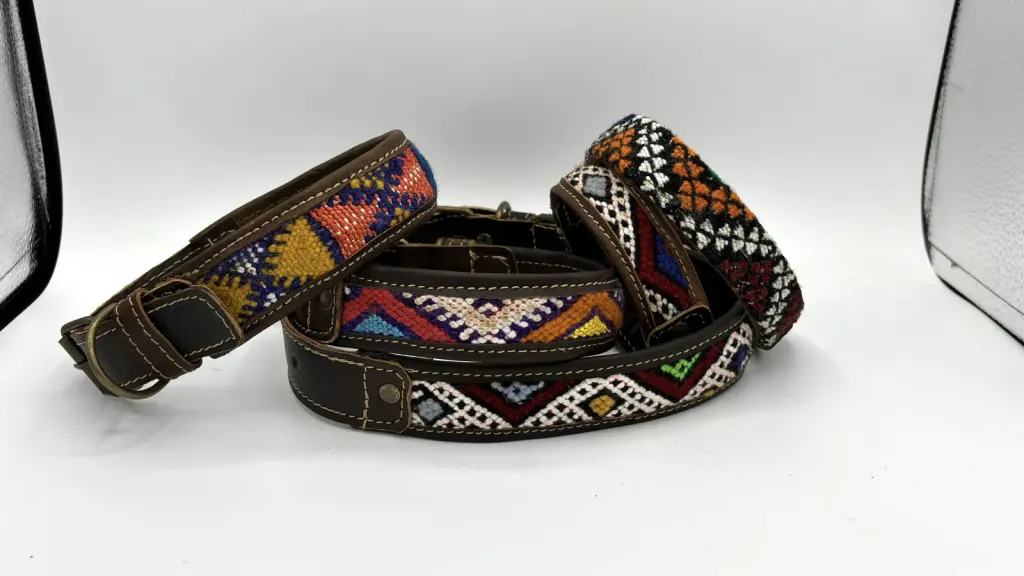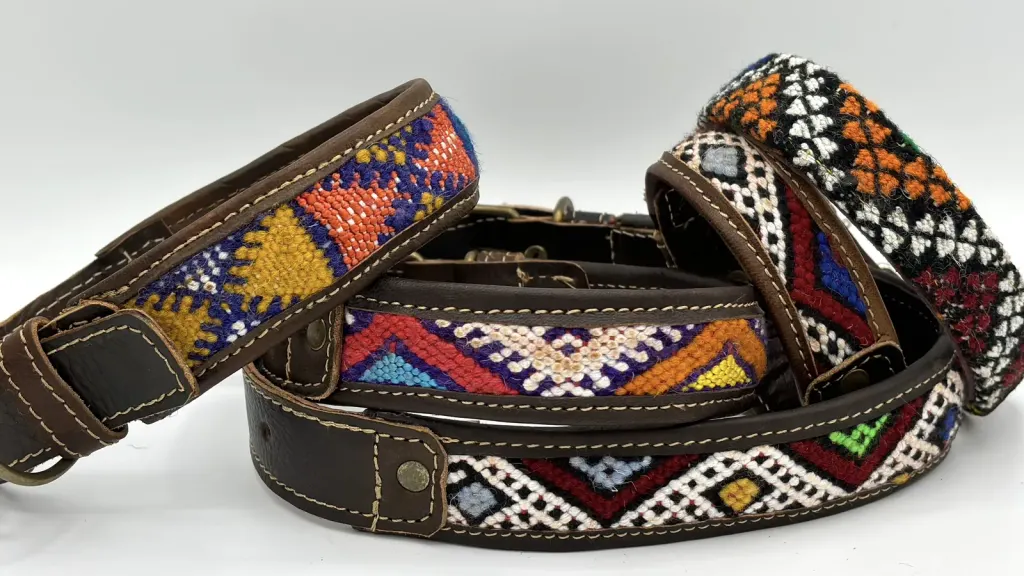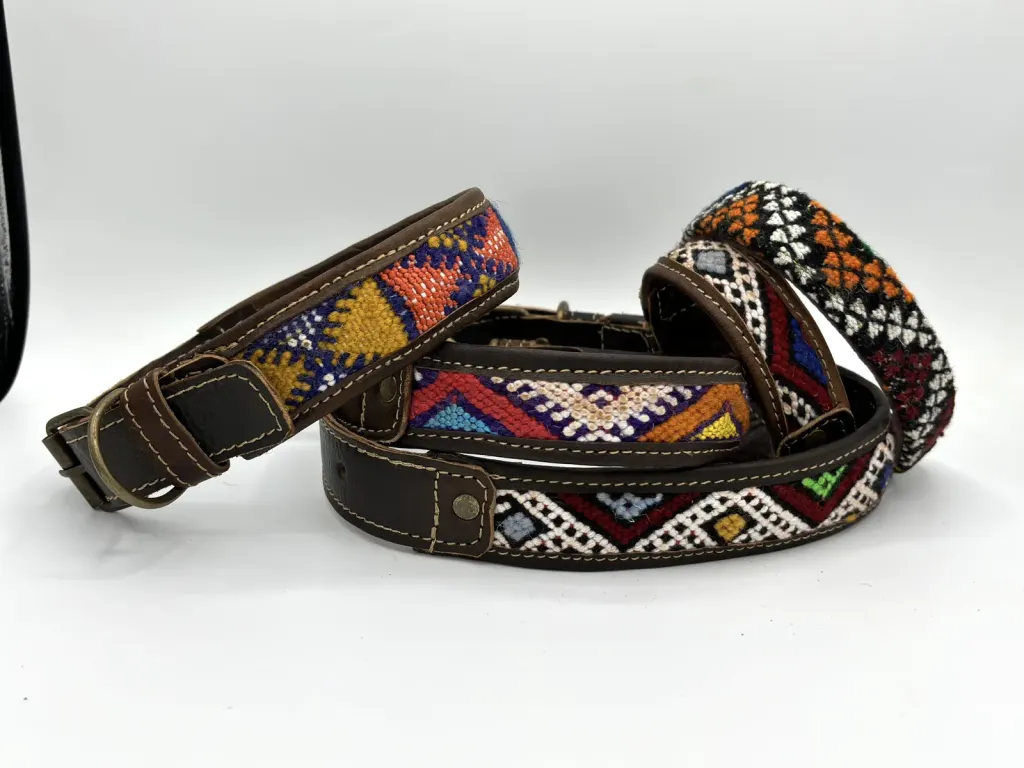
A fabric dog collar made of nylon, polyester or cotton webbing wins on price, weight and easy washing. Leather takes the prize for looks, structure and graceful aging. If your dog swims or wades, pick biothane or nylon. Our own collar is a wool-on-leather hybrid, and it is not meant for swimmers.
We sell one of these types, so you should expect a bias. We’ll say plainly where the other kinds do better.
What counts as a fabric dog collar?
Several different straps hide behind that phrase.
- Nylon webbing: a flat woven strap, common on store shelves.
- Polyester webbing: close cousin of nylon, with its own habits around water.
- Cotton: soft and plain, often printed.
- Coated webbing: webbing wearing a plastic skin. Biothane is the best-known brand.
- Woven textile: a rug-style wool or cotton band, sometimes stitched into a strap.
Leather is no fabric at all. It still gets a row below, since shoppers weigh the two against each other.
How do the materials compare?
Quality swings inside every group. A cheap strap of any kind can disappoint, and a well-made one can surprise you. Take this as a rough map.
| Material | Where it shines | Where it struggles |
|---|---|---|
| Nylon webbing | Strong, flexible, easy to find | Fraying ends if poorly finished |
| Polyester webbing | Sheds water, rinses clean | Plain styling |
| Cotton | Soft hand, casual patterns | Stays damp, can turn musty |
| Coated webbing | Easy wipe-down, made for creeks | Reads as sports gear |
| Hybrid band set in leather | Handmade character | Wants dry weather |
| Leather | Holds its shape, ages with use | Water-shy, heavier |
No dollar figures appear here, because prices jump around between sellers. As a rule, webbing costs least and handwork costs most.
Which fabric is best for dog collars?
Start with how wet your dog gets. Fibres soak up different amounts of water, and one number captures it: moisture regain, the moisture a fibre absorbs from humid air, measured against its dry weight.
A textile reference table gives these ranges:
| Fibre | Moisture regain |
|---|---|
| Polyester | 0.4 to 0.8% |
| Nylon | about 3 to 5% |
| Cotton | 7 to 11% |
| Wool | 13 to 18% |
Polyester absorbs very little, which is why it tends to dry quickly. Nylon lands mid-pack, cotton takes on more, and wool leads the list.
Regain describes humid air, not a plunge into a pond, so consider it a hint only. Even so, the ranking is a sensible guide when you’re choosing a strap for wet days.
What about biothane and similar plastic-skinned straps?
Picture ordinary webbing dipped in plastic. Water beads on top, and mud wipes off with a rag. Many small collar makers build with it. The company behind BioThane coated webbing lists dozens of shops that use it, and several of those pages call their gear waterproof.
Those claims are the shops’ own, and “waterproof” is a big word. Our safer statement: straps with that plastic layer are what creek dogs and puddle fans usually wear.
You pay in feel. The look says trail gear, not heirloom. Some owners love that, while others crave something softer.
Where does leather win and lose?
Structure is leather’s strength. A good strap keeps its curve, takes a buckle cleanly and gains a patina. Our guide to full grain, top grain and genuine leather explains which grades deliver that.
Water is its weakness. According to the Canadian Conservation Institute, most skins and leathers suffer from direct contact with water, though how badly depends on tanning and finish. Some shrink or stiffen after a soaking.
Heft is another leather trait, and the strap wants a little attention. The leather care guide shows that chore takes minutes.
Does weight or comfort change the answer?
Sometimes. Weight matters most on tiny necks. Thin webbing hardly registers on a Chihuahua, while a thick leather strap has real heft. A Labrador rarely notices either way.
Leather also begins stiff and tends to loosen with wear. Webbing feels identical on day one and day three hundred. Small-dog owners can find more in our guide to the best collar for small dogs.
Where does a woven-band hybrid fit in?
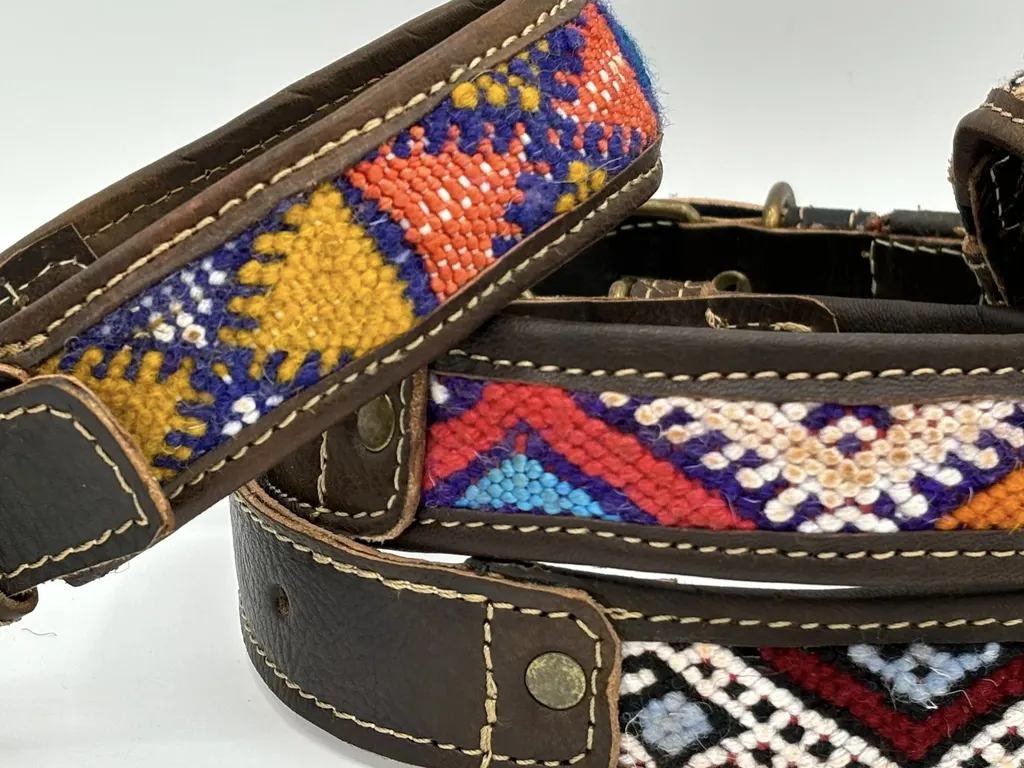
Ours pairs full-grain leather with a handwoven wool band, plus a brass-tone buckle and D-ring. Weavers in Morocco make the band by hand, and the weave is the whole point. Read what a kilim is for the technique.
Honest trade-offs come attached.
Keep it dry. Leather dislikes soaking, and wool absorbs more than any other fibre in the table above. A swim hits both.
Felting can’t be reversed. A University of Wisconsin-Extension lesson explains that wool scales fuse under agitation and a temperature change, and that felting can’t be undone. A washing machine supplies both. We don’t claim our wool is treated against it, which is why the care card forbids machine washing.
Swimmers need something else. Get a coated or nylon strap for lake days, and save ours for drier days. Take it off before swims and baths.
That still leaves plenty: neighborhood loops, trail days, a café patio, photos. Our care page lists the routine, and the materials page shows the weave up close.
How do you choose?
Match the collar to the dog’s week, not the breed.
- Swims or wades often: biothane or polyester.
- Rolls in mud: a coated strap.
- Growing puppy: an inexpensive nylon strap, because pups outgrow collars quickly. The size guide helps with the next one.
- Daily walker on dry ground: leather, or a wool-banded hybrid like ours.
- Needs a spare: nylon, kept in the car.
Plenty of households own two collars, a wet-day strap plus a good-day strap. Sensible. Our comparison of handmade versus mass-produced collars covers what to inspect on any strap.
Frequently asked questions
What is the best fabric for dog collars?
Wet dogs do best in polyester or nylon webbing, or a coated strap such as biothane. Dry-land dogs can wear cotton or a handwoven band, which feels softer and looks richer. Nothing wins on every count, so pick by how your dog spends the week.
Are cloth dog collars safe to leave on all day?
Any collar should let two fingers slide underneath, and the neck deserves a rub-check now and then. Pull a soaked one off right away, since wet straps feel miserable and dry slowly. Ask your vet if your dog has neck or skin trouble.
Is a woven dog collar as strong as nylon?
That hinges on construction. Often the woven band is decoration, while the leather or webbing behind it, plus the stitching and metal, bear the pull. Inspect those parts instead of judging by the pattern on top.
Can I wash a fabric dog collar in the machine?
Plenty of nylon and polyester straps tolerate a gentle hand wash. Read the maker’s label before trying anything else. Ours mixes leather with wool, so we say wipe by hand only, never soak, never tumble.
Prefer handwoven color set into leather, for a dog that stays out of lakes? Shop BohoBarks collars in four sizes, $50 each.